

JOURNAL
Random Thoughts and Adventures

The End of Summer
Summer has pretty much wrapped up at this point, I think that realization hit me right about the same time I took an ice-cold wave to the face kayaking this afternoon, but it also could have been the 35-degree gust that dried me off shortly after. The consequence of that realization set in on the drive home from the river, when I stopped thinking about the lines I wanted to run and the feel of the boat underneath me.
Summer has pretty much wrapped up at this point, I think that realization hit me right about the same time I took an ice-cold wave to the face kayaking this afternoon, but it also could have been the 35-degree gust that dried me off shortly after. The consequence of that realization set in on the drive home from the river, when I stopped thinking about the lines I wanted to run and the feel of the boat underneath me.
We made it through the summer of the COVID. I was fortunate; the only things I lost were my travel plans and some work. I know many dealt with much more challenging circumstances, but the end of this crazy summer is making me realize how much good came mixed into the overwhelming bad around the country and world over the last eight months.
I had to cancel an expedition I had been planning for over a year, but as a result, I spent the summer exploring the Pacific Northwest, one of the coolest places there is! I couldn't work in the Northwest Passage, which allowed me time to play with my niece. My plans to spend time in Costa Rica got axed, and I am sure I avoided some horrible sunburns.
My grand plans would have led to wild stories, and I am disappointed I have lost those opportunities. Alternatively, my lack of projects allowed me the flexibility to form special memories. Which I think are more important than cool stories in the long run. I think people feel a nagging sense that we have to be doing radical things all day, every day. Social media perpetuates that sensation, but I can tell you it is exhausting to be on the road exploring all of the time. After a long trip, I regularly crash for a whole week before feeling physically or mentally prepared to do much of anything. It is probably a better use of our energy to enjoy the simple moments.
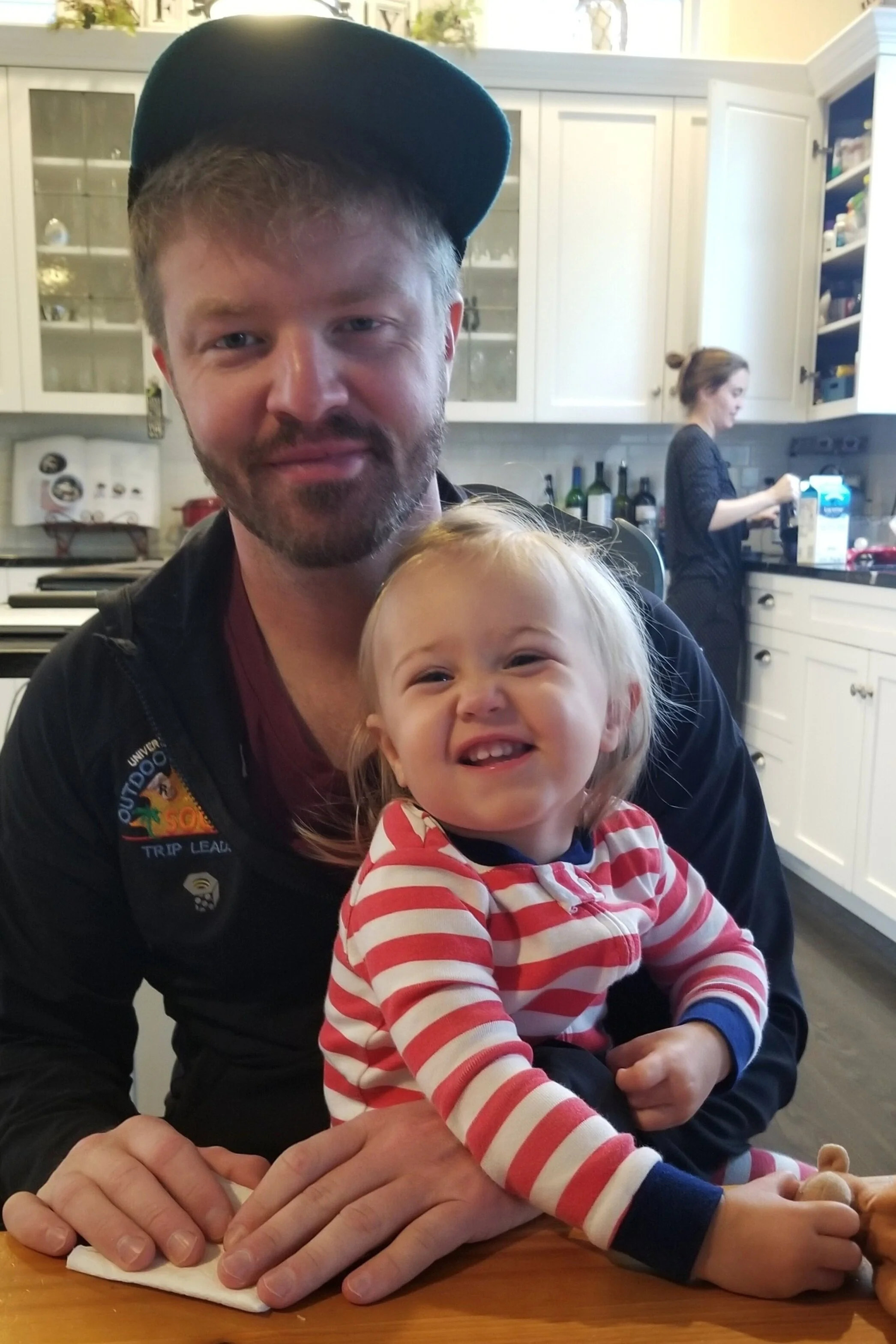
One and a half-year-old humans are just about as coordinated as a dizzy sloth. Although, for my niece, a single dirt-covered rock out of a drainage ditch is more thrilling than almost anything. I'm jealous. It's easy to fall victim to the HD screen with speakers and an unlimited amount of content that sits in my pocket most days. Still, when I think about it, I would rather sit on the sidewalk with the cold, slightly damp concrete soaking into my pants, the sound of the wind in the trees, and some dirt under my fingernails from digging for the smoothest stone.

I thought this before. For some reason, I feel like I am not allowed to just play outside for the sake of playing outside. I need to be kayaking, hiking, shooting photos, or biking. These activities are socially acceptable reasons to be outdoors. I don't know what age it stopped being ok to go outside for no reason. Maybe it was more of a cultural shift, but I suspect I am not the only one who wants some old fashion play. This summer gave me a chance to try that a bit.
The other day, I woke up earlier than I wanted and started spiraling down an outrageous series of news stories about elections, protests, pandemics, and the consequences of our fossil fuel consumption. Though each is very important, not even Atlas could carry the weight of everything happening right now. I decided to give in to the urge to move I get when I am stressed out, excited, or just a bit antsy. At this point, it was about 5:45 in the morning, so tied on my favorite Altra running shoes and went out the door. After the first mile or so of pounding out my frustration, I started to feel lighter. There were still no cars on the roads or people on the trails, and I slowly transitioned from running to a combination of skipping, spins, and slides while singing all the words to "Smooth Criminal" I could remember. I only stopped to watch some deer bipedally stagger around a fenced apple tree to reach the goods. It was way more fun than just running for exercise, but I am sure the few people that saw me thought I was straight-up nuts.
Early in the summer, I was concerned I would not be able to get out kayaking as much as I wanted to while trying to maintain any semblance of social distancing. Kayaking is much more of a team sport than most people imagine. When things are going well, everyone paddles their boat. If not, it's all hands on deck. Consequently, paddling in a group is much safer, and I rarely paddle any noteworthy whitewater by myself.

Unwilling to go full lunatic and play outside without an activity to normalize it, I bought a mountain bike. Biking is not particularly new for me, and I feel safer riding alone than paddling alone. I like how biking challenges me physically and gives me a new set of biomechanics to nerd out about, but my favorite thing is the contrast going up and down. Climbing, I slowly progress with my lungs burning. I feel like time is standing still, and I can think clearly about anything. Mountain bike trails are often built off of logging roads in the northwest, so I regularly think about land management. I am conflicted when I think about lumber. I know it is a vital resource for sheltering people and maintaining our infrastructure. Still, If you have ever walked through the type of old-growth forests that once covered this part of the country, you can only feel sad comparing it to the mess of rotting stumps left behind after the trees reach their economic maturity. That feeling is probably part of what pushed me to live in a tiny home.

Downhill is the exact opposite. Everything is so accelerated; I don't feel the burning in my legs or have time to think. On the good days, it just feels like my body is moving all on its own. This flow state is the most relaxing thing in the world. I don't know the real reason, but I like to think I have shut down my cerebrum, and I am instinctively moving through the forest like a wolf. Sometimes I even howl.
This summer, I lost the chance to learn about myself and explore new parts of the world; however, I am starting to think I learned the same lessons I would have while exploring new trails in my home state.
In a world views class I took during my Master's degree, I learned, among other things, life changes can be the catalyst for new lines of thinking. I had hoped a 90-day expedition would be that catalyst, but as it turned out, COVID-19 came to be one of the most significant changes in my life over the past decade. It has certainly changed how I think and what I value.
On a more global scale, I hope this summer of hardship allows our country and world to reevaluate our culture, policies, and priorities moving forward. As an instructor, I find natural consequences are a far better teacher than me. I can tell a student to put on a rain jacket, but three days of wet clothes will make sure they stay dry in the next storm. Likewise, I think the coronavirus might be a kick in the butt we all needed to see just how flawed our healthcare system is and just how broken our politics are. To see just how much fresh air can benefit our physical and mental health and how human actions can negatively affect the global system. I hope we are all able to find some good that came out of this summer. We have undoubtedly all sacrificed this summer. However, we are left with an opportunity to pivot in a direction for a better future.
Let's start by getting that creepy pumpkin out of office. Then we can reach out to the thousands of people unemployed to develop new sustainable jobs that value social and environmental justice over power and greed. Then, maybe we can all go play outside.

From Qajaq to Kayak
I will probably never use any of my kayaks to harpoon anything. Still, I think it is ok for relics of the past to continue to evolve while still respecting the cultural history. Apply these thoughts to life, politics, or social justice any way you choose, however, I am hopeful readers will be inspired to bring together a more diverse paddling community while respecting the past. At the end of the day, I paddle kayaks, but I hope to honor the legacy of the qajaq and the culture it came from every time I do.

A J.E.C. Rasmussen painting Displayed at the Nuuk Art Museum
Lately, race relations have been front stage in the United States. For the most part, I try to listen and reflect on my role. As part of that reflection, I wrote this a while back, and I thought I would share
Racism comes with all kinds of baggage, and I think addressing it is crucial in our path toward a new, better world. In my experience, culture and race are often connected, if only in the form or heritage. With that, cultural appropriation can be used to demean a group of people. I also think celebrating culture is a powerful way to raise up groups of people. I hope writing this article can help to briefly highlight the evolution of kayaking, and the cultures kayaking came from.
I definitely agree that many examples of cultural appropriation are offensive. I also acknowledge that humans have different cultures because culture continually evolves. I do not come from an underprivileged demographic. Still, I believe respectfully embracing traditions and culture can be a technique to bring people together.
Kayaking is not often considered cultural appropriation, but it is a tradition adopted from another culture, so by definition, it is. With that in mind, I want to acknowledge I have adopted kayaking into who I am, and pay respects to the culture it was taken from.
Kayak is a word from indigenous arctic people, primarily in the North American arctic. These communities are widely known as Inuit, though, different regions referred to themselves differently. Some of these names include Kalaallit, Tunumiit, and Inughuit. Kalaallisut, of the Kalaallit, is still commonly spoken by the small population of Greenland (around 58,000). The languages originally did not have a written form, so it can be spelled in many ways. Before "kayak" became the standard spelling, "kyak," "kayack," "caiack," or "kaiak" were all options. In Greenland kayak is still spelled qajaq.

A J.E.C. Rasmussen painting Displayed at the Nuuk Art Museum
Traditionally qajaq would be a single kayak, while qaannat would be plural. However, the differentiation did not bridge the gap into English. Today, qajaq is only used to describe a true Greenlandic kayak. Qajariaq, meaning "like a kayak," would describe the plastic and composite boats commonly paddled. The word kayak directly translates to “hunter's boat.” Interestingly, in Greenland, I learned kayaks were not thought of as boats but more a prosthetic extension of self. A kayak would be built to fit a hunter based on ratios between their body and the boat. Each community developed unique designs for their kayaks based on the conditions where they paddled.

Skin-on-frame Kayaks Outfitted for a Hunt at the Nuuk Art Museum
Resources in the Arctic are limited even now, but the main materials available came from the sea as driftwood originating in Siberia and the creatures. Greenlandic people moved with the seasons, following food sources. In the summer, they traveled to hunting villages with the entire community in kayaks and uminaks. An uminak is a large open top boat that directly translates to "family boat." Like kayaks, they were constructed with skin, wood, and bone.

Uminak Frame Displayed in the Nuuk Art Museum
Young men had to earn the right to paddle a kayak—part of the process involved learning to roll on ropes. Kayakers were stitched into their kayak, so if they could not roll, they would be forced to cut themselves out of the kayak, and risk hypothermia and drowning. The rolls in the boats were developed to respond to different positions one might be flipped into while hunting. These skills are primarily used for rolling competition now, but the rolls are all transferred from skills that could save a hunter's life.

Kayak Rolling Demonstration in Sisimiut, Greenland
During the seal hunt, the kayakers would position themselves down wind of the seal and paddle toward the seal in a straight line so the animal could not smell them coming. A weathercocking kayak was actually beneficial in these hunts, as it allowed them to paddle harder while steering less. (There was no rudder.) A norsaq was then used to hurl a harpoon into the prey. Depending on the animal, different tips were used.
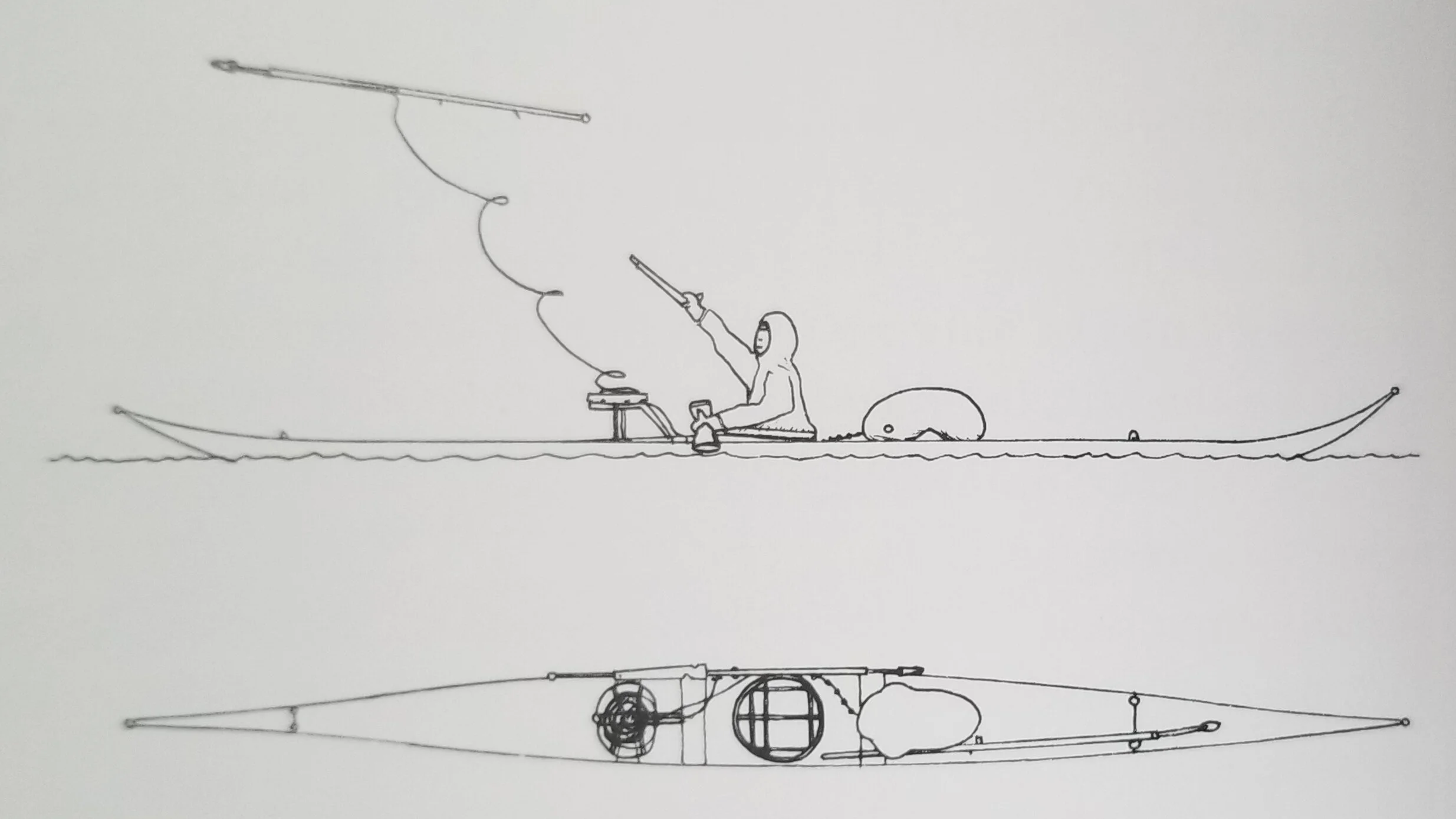
Harpoon Throw Drawing from Harvey Golden's Kayaks of Greenland
As Europeans began trading with these arctic communities, much of their culture was lost and intentionally erased. Some hunters still used kayaks, but many used rifles rather than harpoons. In this time, kayaking became much less common.
The decline in seal and whale hunting as major resources pushed kayaking to be more recreational. Somewhere along the way, kayaks continued to evolve from seal skin to canvas in Greenland. Other places in the world kayak were being noticed for their elegance and functionality.
Like the arctic communities' kayaks, the new generations of kayakers adapted the designs for the conditions they would be paddled in. Like the original kayaks, designs were limited by the construction materials available and technology. Wood boats were easier to make and more durable than the skin on frame. When fiberglass became more available to designers, that became more common. Fiberglass can be molded into complex shapes and are light weight and strong. Kayaks were being paddled in different bodies of water, but it wasn't until plastics became more common that river boating took off. Rotomolding allows a boat to be significantly more durable when bouncing around on rocks.

Eddy Turn in Deception Pass on an Eight Knot Flood
As human technology has evolved, so have the designs of the kayak. We now have incredibly advanced materials that allow us to paddle waters in places that would have been historically unthinkable.
I will always love how my plastic kayaks bounce off of boulders unphased, the speed and rigidity of my fiberglass boats, and how each construction thrives in different environments. However, the day I had the chance to paddle a handmade skin on frame kayak in Greenland will always be a special memory. That is where it all started.
Harvey Golden wrote fantastic books about the history of kayaking and the designs of the boats. I encourage everyone interested to learn more from him.
I believe the paddlesports industry generally takes pride in the history of human-powered crafts. For example, the original Anas Acuta, a classic fiberglass kayak, was a nearly identical replica of a skin on frame kayak built in Greenland in the late 50s. Likewise, Gearlab reimagined the Greenland style paddle into a modern carbon fiber construction but kept many of Greenland paddles' design features. Most notably mirroring their length recommendations to those of a traditional green stick.
Other companies like Kokatat make drastically different products than the historical equivalent. Goretex and latex make far more reliable immersion wear than skins with blubber. However, every product is proudly stamped with Kokatat, a word coming from the language of the Klamath Tribe, meaning "into the water." The Klamath people used dugout canoes as transportation, collecting supplies, fishing, and gathering food around the lakes and rivers around northern California and southern Oregon. The Klamath were, and still are a people dedicated to nature and water, a trait shared by many Kokatat employees and customers.
I will probably never use any of my kayaks to harpoon anything. Still, I think it is ok for relics of the past to continue to evolve while still respecting the cultural history. Apply these thoughts to life, politics, or social justice any way you choose, however, I am hopeful readers will be inspired to bring together a more diverse paddling community while respecting the past. At the end of the day, I paddle kayaks, but I hope to honor the legacy of the qajaq and the culture it came from every time I do.

Speed and Perspective
This is an essay about the coastline paradox and how it applies to our perception of time in the outside.
This gets a bit deep into mathematical theory… if you’re not into that skip to the third paragraph.
There is an interesting issue with exploration known as the coast paradox. It is problem where the smaller the unit of length used to measure a coast, the longer the coast is. For example, a coast line measured in kilometers is actually longer than if it were measured with miles. Even more so if measured with feet. This is because bends in the path occur more regularly, and as we know, the shortest distance is a straight line. From a mathematical perspective, I find it pretty awesome because as the unit of measure approaches 0 distance becomes infinite, so I move infinite distance every time I paddle, bike, or run. So do you.
The other day, I was leading a group and we seemed to be moving slow. I started to think about the coastline paradox for some reason. But this time I went farther down the rabbit hole. Distance is related to speed, so when the unit of length decreases relative speed increases. In truth, speed does not change nor does the distance, but we can manipulate the measurement by adding folds to the measuring tape.

Low tide in the intertidal zone
So why does this matter? If you apply how we can manipulate distance to our perspective, any speed can feel fast paced. A day might drag on if you are using mountains as the reference points, but if you shift your perspective and start using pebbles and seashells as references you might find the day flying past. Although when the end of the day comes you may not have actually left the driveway. I think it is like when you get off of the highway and everything feels super slow until you get used to neighborhood speeds again

Grand Canyon National Park
After I thought up this madness, I have been applying it to day to day life and reflecting back on days that felt boring. I find it much easier to move at the same speed as other people. Similarly, the days that felt slow I was thinking about something far away.
There is no best speed. Anyone who tells you there is, is trapped in their ways. There can certainly be an appropriate speed. When you are racing that speed is as fast as possible. When traveling with a group, it might be a pace comfortable for people to chat. Exercise speed could be something else.
Next time you are outside play with your perspective a bit. Maybe it will help you enjoy it even more. If it works outside, maybe changing reference points will also work to change perspectives at work reducing the stress from a fast paced environment, or to speed things up on a slow day.
Unfortunately, we have not yet mastered time and space, so you will not be able to apply a perspective shift to workout less and get in shape faster.

Dew drops in Alaska